Summary
Solomon's wisdom, a divided kingdom, and prophets who call it back.
by Dr. David Silver4 min read
Read the Summaryby Dr. David Silver4 min read
1 Kings and 2 Kings were one book originally but were divided at the time of the Septuagint (the Greek version of the OT written between the third and first centuries B.C.). They cover the period between the reign of Solomon in 971 B.C. (end of King David’s reign) up until the middle of the Babylonian exile when King Jehoiachin was released in 561 B.C. (about four hundred years). The author is unknown, but Jewish tradition claims Jeremiah as the author.
1 Kings chapters 1-11 deal with Solomon’s reign and the united kingdom of Israel. The second half of the book, chapters 12-22 focus on the divided kingdom. The north (10 tribes) was called Israel, and the south (2 tribes) became known as Judah. Israel had nineteen kings during this time and none of them were considered good kings who pointed the nation towards the Lord. Judah had twenty kings and about eight of them had some positive spiritual influence.
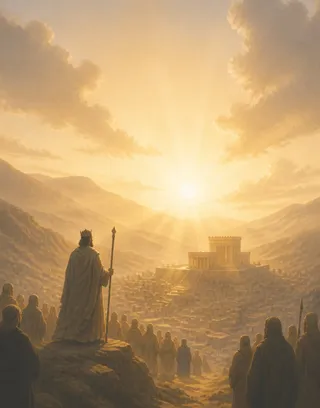
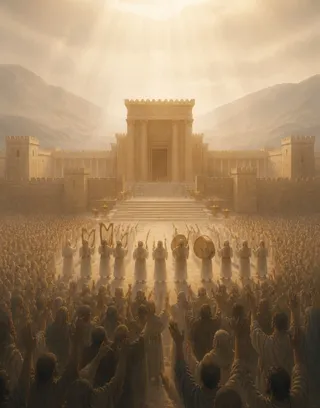
1 Kings begins with an aging King David and his eldest living son, Adonijah, claiming the throne for himself. With help from Bathsheba and the prophet Nathan, David sets up Solomon as king. He gives him a charge to stay true to God (chapter 2) before he dies. Solomon’s throne is established and God gives him wisdom and discernment. Solomon builds the temple and his palace. The ark is brought to the temple, and Solomon dedicates the temple through prayer (chapter 8). God appears to him in chapter 9 and warns him not to turn away to other gods. The Queen of Sheba visits Solomon in chapter 10.
Solomon takes seven hundred wives and three hundred concubines, and his wives turned his heart to worship other gods. God was angry (1 Kings 11: 9) and raises up adversaries against Solomon. This will eventually lead to division in the nation. Solomon reigned for forty years and then rested with his fathers.
His son Rehoboam becomes king and is faced with a dilemma at the onset of his reign. His father had put a heavy yoke of labor and taxes on the people; they were asking for it to be lightened. After consulting with elders and his young friends, he went with his friends’ advice, which was not to lighten things. This caused a rift in the nation, and Jeroboam became the ruler of the ten northern tribes, while Rehoboam stayed in Judah over two tribes.
Jeroboam sets up golden calves in Bethel and Dan to avert his people from going to worship the Lord in Jerusalem at the temple. He becomes the quintessential evil king who turns the hearts of Israel away from God. A man of God comes to the alter at Bethel and prophecies against the alter. Jeroboam is there and his hand is temporarily shriveled and then healed. The man of God is tricked by another old prophet and does not obey the Lord’s instructions. A lion kills him. From that time on, good kings are compared to King David and bad kings to King Jeroboam.
After this, Abijah, Rehoboam’s son, becomes king for three years, and then his son Asa is king for forty-one years. Seven kings of Israel reign during Asa’s reign, including Jeroboam, Nadab, Baasha, Elah, Zimri, Omri, and Ahab. Ahab and his wife Jezebel served Baal (chief deity of a pantheon of ancient gods) and were very wicked. Elijah, the prophet, rose up to oppose Baal worship in the land and to turn the nation back to God.
Elijah prayed it would not rain to discipline Israel and he himself had to be fed by ravens (chapter 17). God sent Elijah to a widow at Zarephath, where he supplied flour and oil supernaturally. When her son became ill and died, Elijah raised him back to life (1 Kings 17: 22). God commanded Elijah to meet Ahab and there was a showdown on Mt. Carmel between God and Baal. Four hundred and fifty prophets of Baal and Elijah made altars, but only God answered with fire from heaven. The false prophets were killed, and rain came on the land again.
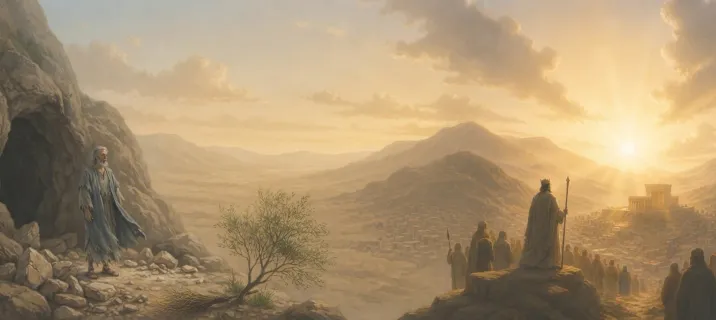
Jezebel threatened to kill Elijah and he ran for his life to Horeb, the mountain of God. After being discouraged and even suicidal, God sent angels to feed Elijah so he could make it to Horeb. The word of the Lord came to Elijah, and he waited for God to pass by (like Moses in Exodus). God was not in the wind, earthquake, or fire, but in a gentle whisper. God sent him to anoint some kings and his protégé Elisha.
1 Kings ends with Ahab and Jezebel killing Naboth and stealing his vineyard. Ahab (king of Israel) and Jehoshaphat (king of Judah, Asa’s son) go to war with Aram despite Micaiah’s prophecy that Ahab would die in battle. He dies and his son Ahaziah continues Baal worship in Israel.
Structure
Chapters 1–11
Solomon is made king and asks for wisdom, builds and dedicates the temple, and then turns to other gods through his wives.
Chapters 12–16
Rehoboam’s harshness splits the nation; Jeroboam sets up golden calves in the north and becomes the measure of every bad king.
Chapters 17–19
Drought, ravens, a widow’s jar of flour, fire on Mount Carmel, and a gentle whisper at Horeb.
Chapters 20–22
Naboth’s vineyard, Micaiah’s unwanted prophecy, and the death of Ahab in a battle he was warned not to fight.
Key Themes
01
Solomon asks for a discerning heart and receives more than he asked.
02
God consents to dwell among His people, though heaven cannot contain Him.
03
What a king worships, the nation worships.
04
Pride at the top tears a people in two.
05
God raises up prophets to confront kings who will not hear.
The Challenge We Face
Jesus speaks of Himself as one greater than Solomon — greater in wisdom, and building a temple not made with hands.
Solomon’s prayer at the dedication asks that God would hear from heaven and forgive; that prayer is answered at the cross. And Elijah, fed in the wilderness and met by God in a whisper, appears again on the mount of transfiguration, speaking with the one every prophet was pointing to.
Apply Scripture
Wisdom is worth asking God for before anything else.
A good beginning does not guarantee a faithful end.
What captures a leader’s heart will shape everyone under them.
God often speaks in a whisper, not in the spectacle.
Discouragement after a victory is common, and God meets people in it.

Study guides
You've seen the big picture. Now explore the book verse by verse with our practical Bible Study Guide.
Related Resources