Summary
Faithfulness in a foreign empire, and the kingdom that outlasts every other.
by Dr. David Silver5 min read
Read the Summaryby Dr. David Silver5 min read
Daniel is a well-known book in the OT with popular stories (the lion’s den, the fiery furnace, the writing on the wall). Daniel is taken in the first wave of exiles to Babylon in 605 B.C. when he was a teenager. His ministry lasted until after the Babylonians were conquered by Medo-Persia in 539 B.C. (he lived into his eighties). In the Hebrew Bible, this book is in the writings (Ketuvim), but he is also considered a prophet and a leader in exile. In the first half of the book, narrative passages tell of Daniel, his three friends (Shadrach, Meshach, and Abednego), and their exploits. In the second half of the book, apocalyptic visions (four of them) point to the future and the Messianic kingdom. Daniel prophesied mostly about events until the coming of the Messiah, while Revelation prophesied about events between the two comings of the Messiah. Daniel’s influence is prominent in twenty of the twenty-two chapters of Revelation. The major theme of Daniel is God’s sovereignty. The book was written in Aramaic between Daniel 2:4 and Daniel 7: 28. The rest was written in Hebrew.
Nebuchadnezzar, king of Babylon, besieged Jerusalem and carried off some of the Israelites from the royal family. Daniel and his friends were among them. He also carried off some of the articles from the temple. Daniel and his friends were taught the language and literature of the Babylonians for three years until they entered the king’s service (1: 4-5). Daniel and his friends resolved not to defile themselves by eating the royal food (1: 8). After ten days they looked healthier than the others and God gave them understanding so they were ten times better than the rest of the wise men (1: 15, 17, 20).
In chapter 2, when Nebuchadnezzar had a dream he wanted interpreted, he would not tell the wise men his dream. He wanted them to tell him his dream and then interpret it. They could not do that, so he ordered them to be executed. Daniel and his friends did not know about the situation until men came to kill them. Daniel tactfully stalled for time, and God revealed the dream and interpretation to him overnight- saving him, his friends, and the rest of the wise men. The interpretation of the dream became a recurring theme in the book: there were going to be four kingdoms, including Babylon, Medo-Persia, Greece, and Rome that would rule the earth. After that, an eternal kingdom would come. Daniel and his friends were promoted.
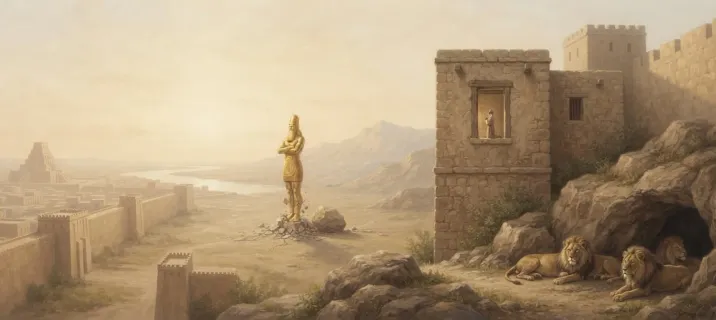
King Nebuchadnezzar responded to the dream by making a statue of gold ninety feet high, which represented his kingdom. When music was played, everyone was to bow to the statue that was set up. Daniel’s friends (apparently Daniel was not there) refused to worship the statue, so they were thrown into a fiery furnace. After they walked around unharmed in the furnace with one that looked like a son of man (a preincarnate Christ), they came out without the smell of fire or any harm (3: 27).
Then Nebuchadnezzar had another dream of a tree which nourished the earth but was to be cut down (he told them the dream this time). Only Daniel could reveal what the dream meant. He warned the king to repent since the tree represented him and it was predicted he would be removed for seven years and be like an animal. A year later, the dream was fulfilled and when he was restored, the king praised the King of heaven. He was humbled (4: 37).
King Belshazzar (a descendent of Nebuchadnezzar) gave a banquet and drank using the articles from the temple in Jerusalem that were taken. A hand appeared writing this omen on the wall: mene, mene, tekel parsin (which meant God has numbered your days; you’ve been found wanting; your kingdom is given to Medo-Persia). Daniel was called to interpret the writing, which was fulfilled that night.
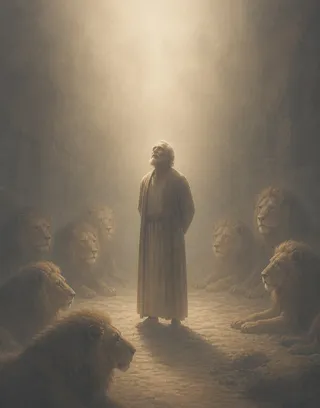
Darius, the Medo-Persian king, who had just conquered Babylon, favored Daniel. Daniel was going to be put in charge of all the administrators. So, his foes devised a plan to have the king sign a decree ordering nobody to pray except to the king for thirty days. Daniel, who prayed three times daily to the Lord, ignored the decree. He was thrown into the lion’s den after the king tried to prevent it. The next day the king cried out in anguish as the stone was being removed from the den. Daniel responded that God had saved him. Daniel’s enemies were then thrown into the den and died before they hit the ground.
Daniel had a dream mentioned in chapter 7 which dealt with the same four kingdoms in chapter 2. In 7: 13 we see the Messiah coming on the clouds as in Revelation 1:7. In 7: 9-14 we get a glimpse of the Throne Room scene which is so prominent in Revelation 4-5. The four beasts mentioned in 7: 1-7 in Daniel are combined into a picture of the anti-Christ in Revelation 13.
Daniel’s second vision in chapter 8 dealt with Medo-Persia and Greece. After Alexander the Great died in 323 B.C., his four generals divided up the kingdom. From these a stern-faced king arose who was Antiochus Epiphanes IV. He caused chaos in Jerusalem and desecrated the temple.
In chapter 9, Daniel prays, knowing from Jeremiah’s prophecy that the exile would last seventy years. Then he is given a third vision of seventy-sevens. They describe the time of the Messiah and a future yet to come. The last vision is described in chapters 10-12. He saw a man reminiscent of Christ in Revelation 1. In chapter 11, Daniel was told of ongoing battles of kingdoms in the north and south. These prophecies cover over three centuries and deal with the kingdoms of Syria and Egypt. These fourteen prophecies were fulfilled in history (see chart in my Daniel study guide for the layperson).
Daniel had to stop his prophecies because the words were closed and sealed up until the time of the end (12: 9). Daniel was a faithful servant of the Lord. The end of the story would come in the book of Revelation.
Structure
Chapters 1–6
The king’s food refused, a dream told and interpreted, the fiery furnace, a proud king humbled, the writing on the wall, and the lions’ den.
Chapter 7
Four kingdoms rise and fall, and one like a son of man comes with the clouds and is given an everlasting dominion.
Chapters 8–9
Medo-Persia and Greece foretold, and Daniel’s great prayer of confession answered with a timetable reaching to the Messiah.
Chapters 10–12
A man clothed in linen, three centuries of wars between north and south foretold in detail, and a promise of resurrection for those who sleep in the dust.
Key Themes
01
God sets up kings and removes them; the empires are on a timetable.
02
Four young men keep their integrity where it costs them.
03
Daniel prays three times a day, in favour and under a death sentence alike.
04
Nebuchadnezzar and Belshazzar both learn that heaven rules.
05
A stone not cut by human hands fills the whole earth.
The Challenge We Face
The title Jesus used for Himself more than any other comes from chapter 7: one like a son of man, coming with the clouds of heaven, given authority, glory and a kingdom that will not pass away. At His trial He quoted it to the high priest.
The seventy sevens of chapter 9 point to an anointed one who would be cut off, and the fourth figure in the furnace walks with God’s people in the fire.
Apply Scripture
Decide what you will not do before the pressure arrives.
God is sovereign over governments that do not acknowledge Him.
Pray consistently in the good seasons and the dangerous ones.
God is sometimes in the fire with His people rather than sparing them from it.
Every empire is temporary; one kingdom is not.

Study guides
You've seen the big picture. Now explore the book verse by verse with our practical Bible Study Guide.
Related Resources