Summary
Moses' final words calling Israel to remember God's covenant, obey His commands, and trust His promises.
by Dr. David Silver2 min read
Read the Summaryby Dr. David Silver2 min read
Deuteronomy (second law) is the fifth book of the bible and last of the Torah. At the time of its writing, Moses and the Israelites are in the Plains of Moab, ready to go into the Promised Land. The next generation has grown up. Moses gives a series of sermons (three discourses) calling Israel to be faithful to God, reiterating, and expanding the law and encouraging them to choose life. It is in the form of a Suzerain-Hittite treaty or a covenant document. Throughout the rest of the OT, the prophets become covenant prosecutors.
In the first four chapters, Moses reviewed the history of Israel in the desert for forty years. After Israel refused to go into the Promised Land, they wandered in the desert until the last person over the age of twenty died. Only Joshua and Caleb from that first generation were allowed to enter, not even Moses. Three times Moses repeated that the Lord would not allow him to cross the Jordan (due to his sin at the waters of Meribah).
Chapter 5 repeats the Ten Commandments, though the Sabbath command focuses more on Israel’s redemption out of Egypt rather than creation (Exodus 20). Chapter 6 includes the Shema in vv.4-5. This very well-known passage challenges Israel not only to hear, but to obey and love the Lord God. Fearing and serving God (v.13) leads to obedience which comes from love and faith. Moses reminds Israel that God chose them, not because they were numerous or great, but because of His love (Deuteronomy 7: 7-8). Moses warns the Israelites not to forget God (chapter 8), or to disobey, or they will be destroyed (vv.19-20).
Chapters 12-26 expound the law. Moses covers topics such as avoiding false worship, idolatry, apostasy, food, tithes, slaves, festivals, authorities, protecting human life, sex, and other commands. Moses begins to expand on the blessings for obedience and curses for disobedience in chapters 27-28. Chapter 29 is about renewing the covenant.
Despite Israel’s repeated disobedience and waywardness, God is faithful and makes a promise. The word is in their mouths and hearts so they may obey it (Deuteronomy 30: 14). Moses asks them to choose life, for the Lord is their life (Deuteronomy 30: 19-20). In chapter 31, Joshua is commissioned to succeed Moses. The Lord tells Moses that Israel will break the covenant and be punished in the future.
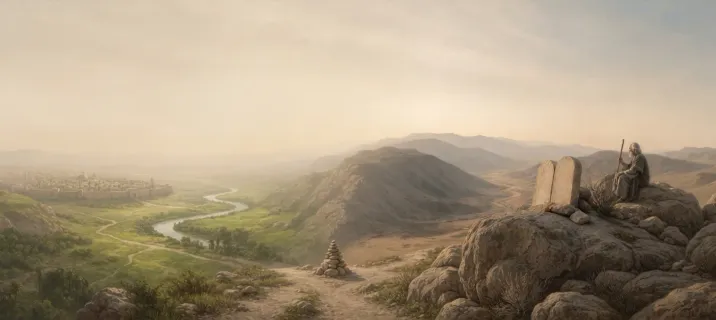
Chapter 32 is a song the Lord gave Moses about God’s faithfulness despite Israel’s unfaithfulness. Moses gave his farewell to the people and went up to Mount Nebo and died. Just before that in chapter 33, he blessed the tribes of Israel (like Jacob on his deathbed). No prophet arose like Moses until the coming of the Messiah (see Deuteronomy 18: 15).
Structure
Chapters 1–4
Moses retells the forty years in the desert and what Israel’s refusal at the border cost them.
Chapters 5–11
The Ten Commandments are repeated and the Shema given: hear, love, and obey the Lord with everything you are.
Chapters 12–26
Worship, justice, leadership, property, family, and the festivals — the covenant applied to life in the land.
Chapters 27–34
Covenant renewal, the call to choose life, the commissioning of Joshua, Moses’ song and blessing, and his death on Mount Nebo.
Key Themes
01
The book is shaped like a treaty, binding a people to the God who rescued them.
02
Obedience flows from love, and love is commanded of the whole person.
03
Israel is told again and again not to forget what God has done.
04
Life and death are set before the people, and they are told to choose life.
05
God chose Israel not for their size or merit, but because He loved them.
The Challenge We Face
Moses promises a prophet like himself whom God will raise up and to whom the people must listen. No such prophet arose until Christ.
Jesus answers every temptation in the wilderness by quoting this book, and names the Shema the greatest commandment. The blessings and curses of the covenant fall on Him, so that the life Moses urged Israel to choose is held out to all who trust Him.
Apply Scripture
Remembering what God has done is how faith stays alive.
Obedience that is not rooted in love will not last.
God chose His people out of love, not because of anything in them.
The word is near you — God’s commands are not out of reach.
Every day sets life and death before us, and asks us to choose.

Study guides
You've seen the big picture. Now explore the book verse by verse with our practical Bible Study Guide.
Related Resources