Summary
Who we are in Christ, and how that reshapes the way we live.
by Dr. David Silver3 min read
Read the Summaryby Dr. David Silver3 min read
Ephesians is a Pauline epistle which is one of the prison epistles (the others are Philippians, Colossians, and Philemon). It is believed that he wrote this book from a Roman prison about 61 A.D. Ephesians is very similar to Colossians and may have been a circular letter passed to different churches in the region. Paul established the church there on his second missionary journey and then spent three years there on this third missionary journey. The major theme of the book is the church and Christ as the head of it (1:22-23). It can be outlined as follows: the calling of the church (chapters 1-3); the conduct of the church (chapters 4-6).
In chapter 1, Paul shares two long sentences (vv.3-14-the longest sentence in the NT; 15-23). In the first sentence, Paul lists the spiritual blessings in Christ that we have as believers: chosen, loved, predestined, adopted as sons, freely given grace, redemption, forgiveness of sins, mystery of the church revealed, hope in Christ, praise of his glory, included in Christ, marked with the seal of the Spirit, guaranteed inheritance. In the thanksgiving section, he mentions the major themes of the letter: knowing God better, Christ exalted to head, heavenly realms, the church.
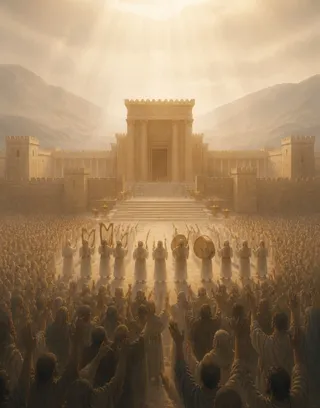
Chapter 2 shows the fullness of God’s grace by painting a picture of man’s depravity (dead in sins, followed the world and Satan, objects of wrath) alongside God’s saving work (in love and mercy, made us alive, saved us, raised us up and seated us in the heavenly realms in Christ, gave us the gift of faith, prepared good works for us to do). God also reconciled Jew and Gentile in the church through the blood of Christ (2:13-16). The new humanity created, the church, is called a household, a building, and a temple (2:19-22).
In chapter 3, Paul shares the mystery that has been revealed, that Gentiles together with the Jews make up the church, the body of Christ. Paul prays for the church that they would be strengthened with power in their inner being through the Spirit, so that Christ would dwell in their hearts by faith (3:16-17). He also prays they would know the great love of Christ and that they would be filled to the measure of all the fullness of God (3:17-19).
In the second half of the book, Paul encourages the church to live out the calling they received (4:1). Believers are to be completely humble, gentle, patient, loving, and keeping the unity of the Spirit through the bond of peace (4:2-3). There is one body, one Spirit, one hope, one Lord, one faith, one baptism, one God and Father of all (4:4-6). Paul lists the gifts given to each one in the church (4:11-13). Each one is to grow in maturity to become more like Christ and God’s people are to reach unity in the faith. Believers are to put off the old self and put on the new self (4:22-24). Believers are to speak truthfully, deal appropriately with anger, and to be kind, compassionate, and forgiving.
Paul exhorts believers to imitate God and to live a life of love as Christ loved us (5:1-2). The church is to live in purity and wisely, making the most out of every opportunity (5:16). We are to be filled with the Spirit (5:18). Paul applies these gospel principles to the household, discussing marriage, parenting, and slaves. Wives are to submit to their husbands, and husbands are to love their wives, just as Christ loved the church (5:22,25). Children are to obey and honor their parents (6:1-3). Parents are to raise their children in the training and instruction of the Lord (6:4). Slaves are to obey and respect their masters (6:5). Masters are to treat their slaves well.
In Ephesus, there was fear of the supernatural, and many repented of their involvement in the occult (Acts 19:17-20). Paul taught how to engage in spiritual warfare and to put on the full armor of God (6:10-20). Our struggle is against spiritual forces in the heavenly realms (6:12). Paul asks for prayer that he would clearly and fearlessly make the gospel known.
Structure
Chapters 1–3
Every spiritual blessing in Christ, dead in sins and made alive by grace, Jew and Gentile reconciled in one body, and Paul’s prayer that they would grasp the love of Christ.
Chapters 4–6:9
One body and one Spirit, gifts given to build maturity, the old self put off and the new put on, and the gospel applied to marriage, children and work.
Chapters 6:10–24
Our struggle is not against flesh and blood; stand firm with truth, righteousness, the gospel, faith, salvation, the word, and prayer.
Key Themes
01
The phrase runs all the way through; identity before instruction.
02
By grace you have been saved through faith — and that not from yourselves.
03
A household, a building, a temple, a body — and Christ its head.
04
One body, one Spirit, one hope, one Lord, one faith, one baptism, one God.
05
A real conflict, fought standing, in armour God supplies.
The Challenge We Face
God’s plan, Paul says, is to bring all things in heaven and on earth together under one head, even Christ. Everything in the letter sits under that sentence.
He is our peace, who made the two one and broke down the dividing wall; He is the head of the body; and His love for the church is the pattern a husband is given for his own marriage.
Apply Scripture

Know what is already true of you in Christ before you work on behaviour.
Salvation is a gift; the good works come after, and were prepared for you.
The dividing walls we keep rebuilding were torn down at the cross.
Maturity is the whole body growing, not individuals getting ahead.
Stand; the armour is for holding ground, not for charging.
Study guides
You've seen the big picture. Now explore the book verse by verse with our practical Bible Study Guide.
Related Resources