Summary
Israel's cycle of rebellion and rescue, showing the need for a faithful King and God's saving grace.
by Dr. David Silver4 min read
Read the Summaryby Dr. David Silver4 min read
After Joshua’s death, but before Israel has kings, three hundred and fifty years pass by. This period was a time of spiritual decline for Israel where they became like the Canaanites in their worship and idolatry. Judges is a book that describes that period. The book is anonymous, but tradition says Samuel was the author. Historic clues put the writing date during the time of Samuel before David becomes king.
The first two chapters are an introduction and chapters 17-21 conclude with the spiritual state of Israel. Chapters 3-16 give narrative accounts of the judges, deliverers that God raised up to lead his people. The recurring cycle found throughout the book is: apostasy—oppression—repentance—deliverance. There are fifteen judges counting Barak, Eli, and Samuel (thirteen in this book). The judges discussed at length were Deborah, Gideon, Jephthah, and Samson.
After Joshua and the elders who outlived him died, another generation grew up who did not know the Lord or what he had done for Israel (Judges 2: 10). They did evil, forsook the Lord, and served the Baals, Ashtoreths, and various gods of the peoples around them (Judges 2: 11-13).
Jabin, a king of Canaan, oppressed the Israelites for twenty years until they cried to the Lord for help. Deborah, a prophetess, was leading Israel at that time. She asked Barak to go to battle against Sisera, commander of Jabin’s army. Barak was only willing to obey if Deborah accompanied him. Deborah went with him but told Barak the Lord would hand over Sisera to a woman (Jael put a tent peg through Sisera’s head). Jabin was eventually destroyed and Deborah and Barak sang a song of victory. The land had peace forty years.
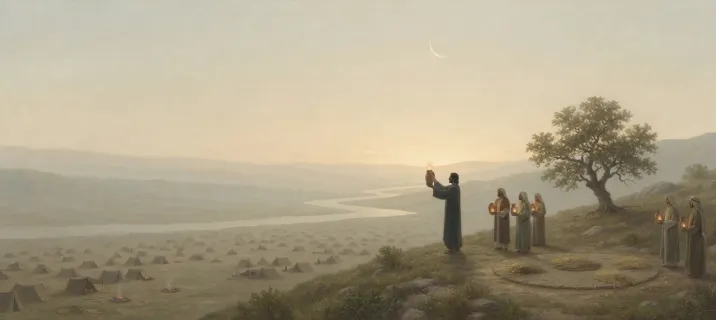
After Deborah, Israel did evil again, and God gave them into the hands of the Midianites. The angel of the Lord appeared to Gideon, who hesitatingly asked for several signs. God granted all of them. After he heard his enemies interpret a dream of their destruction by Gideon, he attacked with three hundred men, trumpets, and torches. The Midianites turned their swords on each other and fled. After Gideon died, the Israelites turned back to Baal again.
God sold the Israelites into the hands of the Philistines, Amorites, and Ammonites. Jephthah was asked to lead a battle against the Ammonites. He vowed to sacrifice whatever came out of his door at home if he was victorious. He won the battle and his daughter greeted him on his return home. He kept his vow.
After Jephthah, Israel did evil and God delivered them into the hands of the Philistines for forty years. The angel of the Lord appeared to Manoah’s wife and told her she would have a child who was to be a Nazarite, though she was sterile and childless. After Manoah prayed, the angel returned and reiterated the message. The angel ascended in the flame of a burnt offering and Manoah, and his wife, realized it was the Lord. The son born was Samson.
Samson had supernatural strength and he was not to cut his hair, eat from the grapevine (or wine) or touch a dead carcass. His eyes got him in trouble. He saw a Philistine woman and wanted to marry her. After riddles during the wedding, betrayal, murders and burned crops, Samson was at war with the Philistines. He killed one thousand of them with the jawbone of a donkey. Later he saw a prostitute and spent time with her, and in the middle of the night he tore up the city gate as the enemy surrounded him. Later, he fell in love with Delilah, who betrayed him after he shared the secret of his strength. He was blinded by the Philistines and put in prison. He was asked to perform in their temple, which he did. Then he placed his hands on the pillars holding up the temple and pushed them apart, killing over three thousand people.
The refrain ‘Israel had no king’ recurs four times in the last five chapters. A man named Micah had a shrine, ephod, and idols. He hired a Levite to be the priest of his home. The tribe of Dan was seeking their inheritance still. They went to the town of Laish and destroyed it and rebuilt it for themselves. They took Micah’s priest for their tribe, and Jonathan son of Gershom, the son of Moses, and his sons were priests for the tribe of Dan.
The book ends with a gruesome story. A Levite took a concubine from Bethlehem. She was unfaithful, but he took her back after four months. On the way back to Ephraim, they stopped in Gibeah in Benjamin. They were taken in by an old man, but people surrounded the house (as in Sodom). The men of the town demanded to have sex with the Levite, but he sent his concubine out to them. She was raped and killed. When this became known, Israel had a civil war against the tribe of Benjamin. Only six hundred Benjamite men survived, and wives were found for them.
Structure
Chapters 1–2
Israel fails to drive out the Canaanites, a generation grows up who do not know the Lord, and the cycle of the book is set out.
Chapters 3–16
Thirteen deliverers are raised up — Deborah, Gideon, Jephthah and Samson at length — each turning back an oppression Israel brought on itself.
Chapters 17–21
Micah’s household idols, the migration of Dan, and the outrage at Gibeah that ends in civil war show a nation with no king and no conscience.
Key Themes
01
Apostasy, oppression, repentance, deliverance — and then it begins again.
02
Israel becomes indistinguishable from the Canaanites it was sent to displace.
03
God works through the fearful, the flawed, and the unimpressive.
04
Every time the people cry out, God answers, though they have no claim on Him.
05
The refrain of the last chapters is that Israel had no king — and needed one.
The Challenge We Face
Every judge rescues Israel for a time and then dies, and the trouble returns. The book is an argument by exhaustion: these deliverers are not enough.
It leaves the reader waiting for a king who is righteous, a deliverer who does not fail, and a rescue that holds — all of which the Gospels announce has come in Christ.
Apply Scripture
Compromise with what God told you to remove will shape you in the end.
Faith is not inherited; each generation has to know the Lord for itself.
God uses people who are weak, reluctant, and far from heroic.
God answers the cry of people who have no right to ask.
Doing what is right in our own eyes is not freedom but ruin.

Study guides
You've seen the big picture. Now explore the book verse by verse with our practical Bible Study Guide.
Related Resources