Summary
Faith, failure, and God's faithfulness through the wilderness journey.
by Dr. David Silver3 min read
Read the Summaryby Dr. David Silver3 min read
Numbers, the fourth book of Moses, contains a census at the beginning and end of the book (hence the name Numbers). The fifth Hebrew word means ‘in the wilderness’. Israel remains encamped at Mt. Sinai for the first ten chapters, and then they move on to near Kadesh-Barnea in the Desert of Paran (chapters 13-19). Israel ends up in the plains of Moab from chapters 22-36. In the transitional chapters they are traveling between locations.
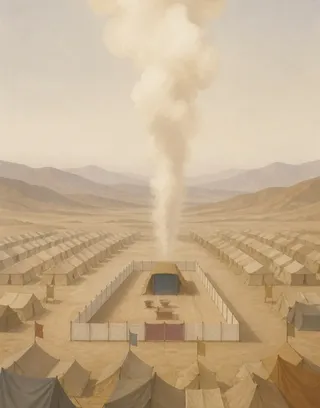
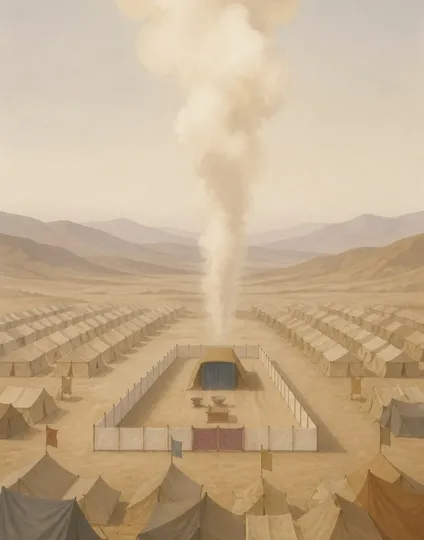
God instructs Moses to take a census of men over twenty who are able to serve in the army, and He gives Moses the names of leaders who names all reflect his character. There are over 600,000 fighting men counted which adding women and children would give Israel an estimated population of about two million. He does not count the Levites as they are to help serve Aaron and his sons with the priesthood. Levi’s three sons (Gershon, Kohath and Merari) and their clans each have tasks related to the Tabernacle and sanctuary. God was communicating peace and security with his priestly blessing.
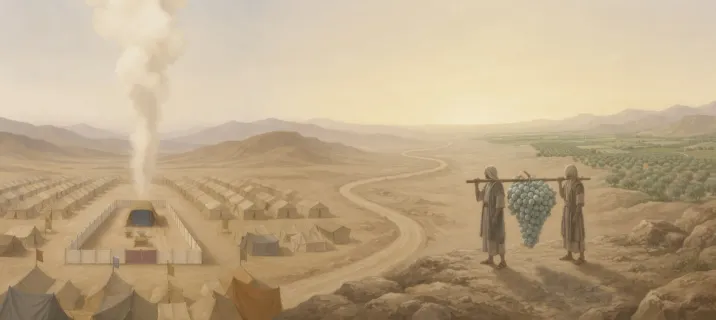
The Tabernacle is dedicated and the Levites are set apart. After celebrating the Passover, Israel set out from the Desert of Sinai and traveled place to place until they came to the Desert of Paran (Numbers 10: 12). Israel complains about their hardships in general, about the food and Moses. But the worst disobedience came with the spies sent out to explore Canaan. Except for Caleb and Joshua, the rest of the spies come back with a bad report and disbelief that Israel can conquer the Promised Land. The Israelites rebel and Moses has to intercede to keep God from destroying them (Numbers 14: 12, 17-20). However, all the spies die in a plague (except Caleb and Joshua), and the Israelites cannot go into Canaan.
Korah and other leaders rose up in rebellion against Moses and Aaron, and the ground opened up and swallowed Korah and his family and fire consumed the other leaders. Then Moses and Aaron failed to honor God at the waters of Meribah, so they were not allowed to go into the Promised Land. Israel journeyed to Moab and defeated the Amorites and Bashan along the way.
Balak, king of Moab, summoned Balaam to curse Israel. Balaam eventually went to Balak after his donkey rebuked him. The donkey saw an angel in the road ready to kill Balaam and tried to protect his master. The donkey had more spiritual sense than Balaam. Balaam uttered over four prophetic oracles but did not curse the Israelites. Instead, Moab tried to seduce the men of Israel with immorality and idol worship, but Phinehas (Aaron’s grandson) put an end to that by driving a spear through Zimri (son of a leader) and Cozbi (daughter of a Midianite leader).
Moses commissioned Joshua to be the next leader of Israel (Numbers 27:23) knowing he would not go into Canaan. After that first generation died in the desert, the second generation was prepared to cross the Jordan. Moses was going to reiterate the law for Israel in the book of Deuteronomy.
Structure
Chapters 1–10
Israel is counted and ordered for the march, the Levites are set apart for the tabernacle, and the people set out from the mountain.
Chapters 11–19
Complaints about hardship and food give way to the spies’ bad report, and a generation is barred from the land.
Chapters 20–21
Korah’s rebellion, the waters of Meribah, and the long years between the promise and its keeping.
Chapters 22–36
Balaam blesses the people he was hired to curse, a second census is taken, and a new generation is prepared to cross the Jordan.
Key Themes
01
The land is lost not to a stronger enemy but to a failure to trust God.
02
Complaint against Moses is complaint against the God who sent him.
03
Moses stands between a guilty people and the judgment they deserve.
04
Even Moses and Aaron are held to what God has said.
05
God’s promise outlives the generation that refused it.
The Challenge We Face
When the people are dying of snakebite, Moses lifts a bronze serpent on a pole and all who look at it live. Jesus takes that moment for Himself: as Moses lifted up the serpent, so the Son of Man must be lifted up.
Moses interceding for a people under judgment, and Balaam’s oracle of a star rising out of Jacob, point the same way.
Apply Scripture
Unbelief, not opposition, is what keeps people out of the promise.
God is patient, and His patience is not permission.
Faithful minority reports are often right; Caleb and Joshua stood nearly alone.
Leaders are accountable for how they represent God.
God’s purposes survive a generation that abandons them.

Study guides
You've seen the big picture. Now explore the book verse by verse with our practical Bible Study Guide.
Related Resources