Summary
The day of the Lord, and the God who rejoices over His remnant with singing.
by Dr. David Silver2 min read
Read the Summaryby Dr. David Silver2 min read
Zephaniah is a minor prophet whose book is one of ‘The Twelve.’ His name means ‘The Lord hides.’ He prophesied about the time that King Josiah began to reign in 640 B.C. He had a lineage going back to King Hezekiah. At this point in history, the southern kingdom of Judah was in spiritual decline. Zephaniah, along with Habakkuk and Jeremiah, warned of Judah’s coming judgment. His book can be divided by its chapters: chapter 1 deals with the day of the Lord; chapter 2 discusses judgment on the nations; chapter 3 shows Judah’s future.
From the start of this prophecy, Zephaniah is warning of coming destruction on the earth, alluding to creation in 1: 2-3. God is going to discipline Judah for its waywardness, idolatry, and worshipping Baal and Molech (1: 4-5). The day of the Lord is near (1: 7). God will punish Jerusalem (1: 12). The wealthy think they will be safe (1: 12). The day of the Lord foreshadows Judah going into exile to Babylon (586 B.C.) as well as future judgment.
In chapter 2, Zephaniah exhorts Judah to seek the Lord and to seek humility and righteousness before the wrath of God comes (2: 1-3). God will also judge the nations: Philistia (2: 4-7); Moab and Ammon (2: 8-11); Cush (2: 12); Assyria (2: 13-15). God is against those who have been enemies of his people as he told Abraham ahead of time (Genesis 12: 3). He will restore the fortunes of a remnant of his faithful followers (2: 7,9). Though the Assyrians were still in power when this prophecy was written, they would soon be defeated by the Babylonians in 605 B.C. at the battle of Carchemish.
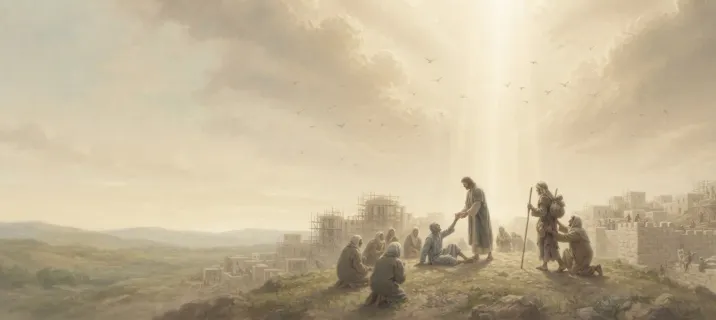
In chapter 3, it is foretold that Jerusalem will be destroyed, but God will have a remnant of Israel that does no wrong, who are meek, humble, and trust in the Lord (3: 9-13). He encourages the Daughter of Zion to sing and rejoice in 3: 14, and God also will sing over them with rejoicing in 3: 17. The Lord is with them (3: 15, 17). He is mighty to save (3: 17). The Lord will gather his people and bring them home (3: 19-20). He will give his people honor and praise and restore their fortunes (3: 20).
Structure
Chapter 1
A sweeping judgment on Judah for idolatry and on the complacent who say the Lord will do nothing, good or bad.
Chapter 2
A call to seek righteousness and humility before the day comes, with oracles against Philistia, Moab, Ammon, Cush and Assyria.
Chapter 3
Jerusalem rebuked, then promised a humble remnant who trust the Lord — and a God in their midst who is mighty to save and who sings over them.
Key Themes
01
Named more often here, proportionally, than anywhere else.
02
The wealthy who assume God is not paying attention.
03
Seek the Lord, all you humble of the land; perhaps you will be sheltered.
04
A people left who speak truth and do no wrong.
05
He will rejoice over you with singing — one of the most surprising lines in the prophets.
The Challenge We Face
The book ends with the Lord in the midst of His people, mighty to save, quieting them with His love and rejoicing over them with singing.
That is the promise of Immanuel — God with us — kept in Christ, who gathers exactly the kind of humble remnant Zephaniah describes and brings them home.
Apply Scripture
Assuming God will not act is its own kind of unbelief.
Seek humility before trouble makes you humble.
God preserves a faithful remnant in the worst seasons.
He is not only willing to save but glad to.
God sings over His people; let that sink in.

Study guides
You've seen the big picture. Now explore the book verse by verse with our practical Bible Study Guide.
Related Resources